A useful answering system turns a missed ring into a clear next action for the customer and the dispatch team.
An HVAC call can arrive while the office is busy, a technician is on a job, or the on-call person is handling another customer. Call automation can help recover that conversation, but products in this category differ sharply in workflow, safety, and proof.
This guide explains the category without assuming that every vendor works the same way.
What HVAC Revenue Autonomy does
The useful version of the product is more than a message recorder. It should:
recognize the reason for the call;
collect the contact and service details your team actually needs;
follow your service-area and scheduling rules;
identify safety-sensitive language and apply a defined escalation path;
preserve the conversation as an auditable record; and
hand the result to your team in a usable format.
Vectrion focuses on missed-call recovery for residential HVAC contractors. It publishes timestamped machine-event evidence but no unsupported numerical speed result.
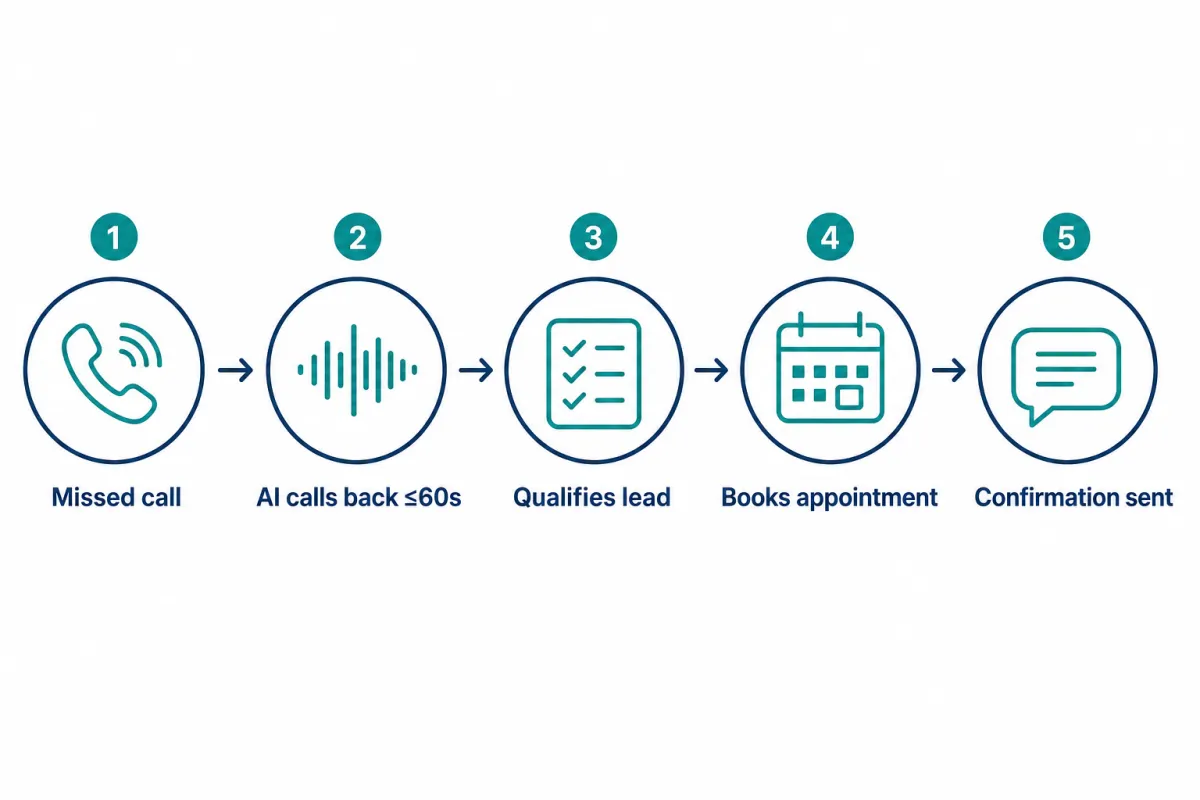
How the recovery workflow should operate
Detect the missed call. The system receives the event from the approved phone workflow.
Return the call. The caller hears a clear introduction tied to the HVAC company.
Gather the job context. The system asks for the service need, location, urgency, and scheduling preferences.
Apply routing rules. Safety-sensitive or complex situations follow the contractor's documented escalation path.
Create the handoff. The office receives structured information and can approve the next action.
The contractor should be able to inspect each transition, not merely trust a vendor summary.
AI answering versus a traditional answering service
A traditional service may be the right fit when a contractor wants a live human to take messages. An AI system may be a better fit when the contractor needs consistent structured capture, configurable routing, and an auditable workflow.
The label matters less than the actual handoff. Ask to see what reaches the dispatcher after a realistic call. A free-text message, a structured record, and a confirmed booking are different outcomes and should not be described as interchangeable.
Ask which systems the vendor can write to today and which rely on a dispatcher handoff. Request a demonstration using the same fields your team requires.
Test emergency routing
Use realistic safety scenarios and verify that the system follows your approved language and escalation policy. It should never improvise technical or emergency advice.
Inspect the audit trail
You should be able to review what the caller said, what the system captured, what action it took, and why. Evidence should come from your own calls rather than a blended industry average.
Test difficult conversations
Include interruptions, background noise, incomplete addresses, frustrated callers, unsupported requests, and requests for a person. The fallback behavior matters as much as the happy path.
Separate capture from booking
Ask whether the system captures booking details, writes directly to a dispatch platform, or confirms an appointment. Those are distinct capabilities. The vendor's language should match the product that is live for your account.
How to assess value without borrowed benchmarks
Start with your own phone report. Identify missed calls, trace what happened next, and compare the recovered outcomes with an agreed holdout. Use your own booked-job records and revenue records to judge performance.
That method avoids speculative market percentages and generic revenue models. It also gives an HVAC owner a direct answer to the question that matters: did the system recover work that the existing process would have lost?
Use outside research to shape the test. Use your own call, booking, and revenue records to judge the product.
Implementation questions to settle before launch
Which number and call state trigger the workflow?
What must the agent disclose?
Which service areas and job types are supported?
What language is used for safety-sensitive situations?
When does the system transfer, notify, or stop?
What record appears in the dispatcher's normal workflow?
How will the contractor compare recovery against a holdout?
Deployment timing depends on the approved setup and the systems involved. The written onboarding plan should identify what is ready, what is blocked, and what evidence will mark the workflow live.
Frequently asked questions
What is HVAC Revenue Autonomy?
It is software that answers or returns calls, collects structured service details, and follows the HVAC contractor's routing rules. The exact capabilities depend on the vendor and integration.
How fast can Vectrion return a missed HVAC call?
Vectrion publishes the clock definition and timestamped event method used to inspect the callback path. This page does not publish a numerical speed result because it does not include the evidence required to reproduce one.
Does it replace the office team?
It does not need to. A sensible workflow handles repeatable capture and routing while people retain control of exceptions, approvals, and customer relationships.
How should an owner compare providers?
Run realistic test calls, inspect the resulting handoff, verify escalation behavior, and require measurement on the owner's own leads. Avoid choosing from an unsupported market average or a polished demo alone.
What should happen when the AI is uncertain?
The system should follow a documented fallback, preserve context, and route the situation to the right person. The contractor should test and approve that behavior before launch.
The bottom line
The best HVAC call automation system is not the one with the loudest performance claim. It is the one that fits the contractor's workflow, handles edge cases safely, produces a useful handoff, and proves recovery with the contractor's own records.
Frequently asked questions
What is HVAC Revenue Autonomy?
HVAC Revenue Autonomy recovers eligible missed calls, gathers the caller's needs, records a structured next step, and measures the recovered outcome from the contractor's own records.
How fast can Vectrion return a missed HVAC call?
Ask to inspect the callback clock definition and its timestamped event evidence. Vectrion does not publish a numerical speed result here because this page does not carry the evidence needed to reproduce one.
Does HVAC AI integrate with dispatch software?
Integration depends on the vendor and platform. Ask whether the service writes directly to your system or produces a structured handoff for your dispatcher, and verify the current workflow before signing.
How much does HVAC call automation cost?
Pricing depends on the service and operating scope. Compare a private quote with your own missed-call volume, booking value, and the quality of the vendor's measured evidence.
Will callers know they are talking to AI?
Voice quality varies. Evaluate disclosure behavior, interruption handling, clarity, and accuracy with realistic test calls before choosing a service.
What happens when the AI cannot handle a call?
A well-designed system follows documented escalation rules, preserves the call context, and routes the situation to the appropriate person. Test those edge cases before launch.
Two free ways to find out, neither of which commits you to anything. Test your line and we will call it the way your customers do and send you the log. Or send your last 90 days of call logs and get a written audit back — yours to keep either way.